AstroMatrix Birth Horoscopes
- 4.6
- Rating
- 1.00M
- Installs
- Free
- Price

 Analysis by App-foxy
I approached AstroMatrix Birth Horoscopes as a reflective lifestyle app rather than a tool that can prove what will happen next. Its appeal is the way it brings several astrology activities into one mobile space: birth-chart reading, relationship comparison, tarot, and daily horoscope content. I found that combination more useful for people who enjoy exploring patterns and personal symbolism than for anyone looking for a quick, one-line prediction.
The app is made by AstroMatrix and has been available since November 3, 2015. It is free to start, aimed at Everyone, and has built a sizeable audience, with more than a million installs, an average rating of 4.6, and roughly thirty-one thousand ratings. Those figures suggest that it has become a familiar choice in the lifestyle section, but popularity alone does not make every part of the experience equally suitable for every reader.
How the astrology experience works in everyday use
The first thing I noticed is that the app asks for a little more attention than a typical horoscope widget. A daily horoscope can be read quickly, but a birth chart invites you to slow down and examine several parts of a personal profile. That makes the experience feel richer, although it also means the app is not instantly satisfying if you only want a short message during a coffee break.
You May Also Like

 Blood Strike: 2.5 Anniversary
Blood Strike’s Loadouts Turn Every Drop Into a Tactical Gamble
A close look at Blood Strike’s custom loadouts: how fast access to signature weapons reshapes its battle royale rhythm, rewards preparation, and narrows the gap between fights.

 Pandora - Music & Podcasts
Pandora’s Music Is Easy to Start, but Harder to Recover
Pandora’s strength is its low-effort path from a seed to a station. Its weak spot is how much confidence it asks you to place in connection, setup, and quiet recovery.

 8 Ball Pool
 Is Built on Rivalries, Rematches, and Routine
A close look at the rivalries, rematches, shared routines, and unanswered safety questions that turn a quick pool match into a persistent mobile community.

 Samsung Music
’s Quiet Strength Is Playing What You Already Own
Its reach comes less from spectacle than from dependable access to a personal library. That simplicity is both the app’s strongest retention engine and its ceiling.

 AccuWeather: Weather Radar
AccuWeather Review: A Quick, Clear Forecast for Everyday Decisions
For everyday plans, the best forecast is the one you can understand quickly. AccuWeather makes rain timing, radar, and local conditions easy to act on, with a few trade-offs.

 Hill Climb Racing
Why Hill Climb Racing Still Turns Crashes Into One More Run
A tiny car, a bumpy hill and one more upgrade: Hill Climb Racing keeps resurfacing because its simple chaos makes every near-miss feel personal.
More From Our News Desk



Birth-chart material is the strongest reason to spend time here. Instead of treating astrology as a single daily sentence, the app encourages you to look at how different chart elements fit together. I found that especially helpful when I returned to the same chart with a specific question in mind, such as why I approach work cautiously or why certain relationship patterns keep appearing in my reflections.
The relationship side adds another layer through synastry charts. This is more useful when approached as a conversation starter than as a compatibility verdict. I would not use it to decide whether to begin or end a relationship, but I can see the value in comparing two charts before discussing communication habits, expectations, or recurring sources of tension. The chart gives the discussion a structure; the people involved still need to supply the judgment.
Tarot and daily horoscopes make the app easier to open casually. They offer a lighter entry point for days when I do not want to study a full chart. At the same time, moving between quick readings and detailed chart material can make the experience feel broad rather than tightly focused. Someone who wants only tarot may find the astrology sections distracting, while someone interested in chart analysis might treat the daily material as a pleasant extra.
Why the phone setting changes the experience
On a phone, the app works best in short, intentional sessions. I would use it on a quiet train ride, before journaling, or at the end of the day when I have enough patience to read rather than skim. A small screen is convenient for checking a daily horoscope, but it is less comfortable for comparing several chart details at once. The more interpretive the reading becomes, the more useful it is to pause and make notes elsewhere.
A realistic routine would be to open a daily reading in the morning, save a thought that feels relevant, and return later to a birth-chart section when there is more time. That approach prevents the app from becoming a stream of disconnected predictions. It also makes the content more personal because I am relating it to an actual event instead of judging it immediately as accurate or inaccurate.
Another practical use is preparing for a thoughtful conversation. I might look at a synastry chart before talking with a partner about a repeated disagreement, not to present the chart as evidence, but to identify themes worth discussing. The important trade-off is emotional distance: if the conversation is already tense, introducing astrology can help one person reflect, but it can also sound like an attempt to avoid direct responsibility.
The app is less convincing when used as a constant notification-style authority. Checking every horoscope several times a day can encourage overinterpretation, especially when ordinary events are made to fit broad language. I recommend treating readings as prompts for self-observation. If a statement does not fit, there is no benefit in forcing it to fit.
Connectivity and moments when the app needs more patience
Because the experience revolves around generated readings and chart content, connectivity can shape how smoothly a session goes. In a strong connection, moving from one section to another feels natural. In a weak or changing mobile signal, I would expect the experience to be less predictable, particularly when content has to load or a new reading is being opened.
This matters most when using the app away from home. On a subway, in a crowded venue, or in a building with poor reception, I would avoid starting a deep chart session that I cannot easily finish. A daily horoscope may be a better choice for those moments, while a longer reading belongs in a place where the connection is steady and interruptions are less likely.
I would also avoid tapping repeatedly when a page seems slow. Repeated requests can make it harder to tell whether the app is processing the first action or whether nothing happened at all. My practical habit would be to wait, check the connection, and reopen the relevant section only if necessary. That sounds simple, but it prevents a reflective session from turning into a frustrating battle with the interface.
The network-dependent aspect is not a reason to reject the app, but it changes when I would recommend using it. It is better suited to planned or semi-planned moments than to situations where I need instant access under difficult signal conditions. Readers who regularly travel through areas with unreliable service should keep their expectations modest and avoid depending on it as their only source of personal notes or guidance.
What happens when a reading is interrupted
Interruption is particularly annoying with interpretive content because it breaks concentration. If a call arrives, the phone switches tasks, or the connection changes, I would not try to reconstruct an important conclusion from memory. I would return to the same topic later and read it again with a clear head. That is also a useful safeguard against treating a half-read passage as a complete message.
For a more reliable personal workflow, I would keep a separate journal entry with the date, the question I had in mind, and my own reaction. This is one of the most useful ways to use the app without becoming dependent on it. The app supplies material for reflection, while the journal preserves what I actually thought and experienced. If a session fails, the meaningful part of the process is not lost.
That workflow also reveals a limitation: the value of the app depends partly on what the user does around it. Someone who wants a fully automatic record of every insight may find the experience less convenient than a dedicated notes or journaling app. AstroMatrix is a source of readings, not a replacement for a personal system of reflection.
I would be especially careful with relationship readings after an argument. A disrupted or hurried session can encourage selective reading, where I focus only on lines that support what I already feel. Waiting until emotions settle makes the material more useful. In my view, the best recovery from a failed session is not simply reopening the app; it is returning with a narrower question and less urgency.
Using it thoughtfully on mobile data
The app is free to download and use, which makes it easy to try without an upfront purchase. It also includes optional in-app purchases ranging from $1.49 to $49.99 per item. I would look carefully at any purchase screen before confirming, especially if I had already spent time exploring several sections and felt invested in continuing. Free access is a good starting point, but the presence of paid items means I would not assume every desirable part of the experience is included at no cost.
For data-conscious use, I would open longer readings while connected to a trusted network when convenient, avoid refreshing the same page repeatedly, and close the app when I am finished rather than leaving it active during a long trip. These are ordinary habits, but they matter when a reading session is more substantial than a quick glance. I would also keep my own notes outside the app so that the interpretation remains useful even when I am not connected.
Privacy is another reason to be deliberate with personal information. Astrology apps naturally feel personal because birth details and relationship comparisons can be emotionally sensitive, even when the user is treating them casually. I would enter only what I am comfortable using for this purpose and would avoid adding another person’s details without their knowledge. The app may be entertaining, but the subjects of a chart are still real people.
There is also a psychological form of data-consciousness: deciding how much authority to give the information. If I record every prediction and then search for evidence that it came true, I am feeding the app more influence over my attention than it deserves. A better approach is to use readings selectively, write down my independent view first, and then compare it with the interpretation. This makes the experience more reflective and less suggestible.
Who will appreciate the combination of charts, tarot, and horoscopes
I would recommend the app to someone who wants more than a daily horoscope but does not want to assemble several separate astrology tools. Its combination of birth charts, synastry, tarot, and daily readings gives curious users room to move between detailed and casual exploration. Beginners can start with a short reading, while more engaged users can spend time examining personal and relationship themes.
It is also a good fit for people who already journal, meditate, or use prompts for self-reflection. The app works particularly well when its material becomes a question rather than an answer: “Why did this stand out to me?” is more productive than “Does this guarantee what will happen?” That distinction is what separates a thoughtful experience from passive fortune-checking.
I would skip it if I wanted scientific forecasting, professional counseling, or decisive relationship advice. The app cannot replace a therapist, doctor, financial adviser, or honest conversation with another person. I would also hesitate to recommend it to someone who becomes anxious after reading predictions or feels compelled to check for reassurance. In that situation, the daily content may add noise instead of comfort.
Compared with a simple horoscope app, this one offers more depth through chart-based exploration. Compared with a dedicated tarot app, it spreads attention across several traditions instead of centering entirely on cards. Compared with a general journaling app, it provides ready-made prompts but less control over how personal reflection is organized. The right choice depends on whether you want interpretation supplied for you or a blank space in which to develop your own thoughts.
Version, accessibility, and the overall learning curve
The current version is 10.9.8 and it runs on Android 7.0 or later. That gives the app a relatively broad reach for people using older supported phones, although the experience will still depend on the device, screen size, and network conditions. I would check compatibility before planning to use it on an older handset, particularly if that phone already struggles with modern apps.
The Everyone content rating makes the app approachable for a wide audience. That does not mean every interpretation will feel equally comfortable for every person. Astrology and tarot can touch on emotionally charged subjects, so younger users may still benefit from guidance about treating the material as entertainment and reflection rather than certainty.
The learning curve is moderate. A daily horoscope is immediately understandable, while birth charts and synastry take more time to interpret. I found that the best way to learn is to focus on one question at a time instead of trying to understand every chart element in a single sitting. That approach reduces the sense of being overwhelmed and makes the app feel more personal.
One non-obvious strength is the ability to change the pace of engagement. I can use it for a brief morning check-in, a longer personal reading, or a relationship-focused conversation starter. One non-obvious weakness is that this breadth can make the app feel less disciplined: without a clear purpose, it is easy to jump from one reading to another and finish without remembering anything useful.
My final view on staying connected to the experience
After spending time with AstroMatrix Birth Horoscopes, I see it as a flexible astrology companion rather than an authority. Its best qualities are the range of material, the move from quick horoscopes to more involved chart work, and the way synastry can give people a shared language for discussing relationships. Its weaker side is the need for self-control: connectivity interruptions can break a session, paid items require attention, and broad interpretations can become unhelpful when taken too literally.
I would install it if I wanted to explore astrology from several angles in one place and was comfortable doing some interpretation myself. I would use it with a stable connection, keep personal notes separately, and treat each reading as a prompt to examine my choices rather than a command to follow them. If I needed a purely offline journal, a narrowly focused tarot tool, or professional guidance, I would choose something else.
My recommendation is cautious but positive: AstroMatrix is worth trying for curious, reflective users who enjoy birth charts, relationship comparisons, tarot, and daily horoscope content. The free starting point lowers the barrier, while the optional purchases mean I would make decisions slowly. Used with that balance, it can turn a few minutes on a phone into a useful moment of self-reflection without asking me to surrender my judgment.
FAQs for AstroMatrix Birth Horoscopes
01What is AstroMatrix Birth Horoscopes used for?
AstroMatrix Birth Horoscopes is an astrology app designed to help you explore your birth chart, planetary placements, zodiac signs, houses, and aspects. After entering your birth date, time, and location, the app presents personalized interpretations and horoscope information. It is mainly intended for self-reflection, learning about astrology, and exploring personality themes rather than providing scientifically verified predictions.
02Do I need my exact birth time and location to use AstroMatrix?
You can usually create a chart with your birth date and location, but an accurate birth time is strongly recommended. The time affects your rising sign, house positions, and several chart calculations, so an incorrect or unknown time may produce less reliable results. If you do not know your exact birth time, the app may still offer general information, but some features and interpretations can be limited.
03Is AstroMatrix Birth Horoscopes free to download and use?
AstroMatrix can generally be downloaded at no initial cost, but availability of features may depend on the current app version, platform, and subscription options. Basic chart information may be accessible for free, while deeper interpretations, additional reports, compatibility tools, or other advanced content may require in-app purchases or a premium plan. Check the store listing and subscription terms before confirming payment.
04What features can I expect after creating a birth chart?
After entering your personal birth details, AstroMatrix typically provides access to a visual natal chart along with explanations of planets, signs, houses, and aspects. Depending on the version, you may also find daily or transit horoscopes, relationship or compatibility readings, saved charts, and educational astrology content. The exact tools can change, so review the current feature list before downloading.
05Can AstroMatrix Birth Horoscopes accurately predict my future?
AstroMatrix offers interpretations based on traditional and modern astrological systems, but its readings should be treated as guidance for entertainment, curiosity, or personal reflection. Astrology is not scientifically established as a method for predicting events or making dependable decisions. Avoid using the app as a substitute for professional medical, financial, legal, or psychological advice, and consider its predictions thoughtfully rather than literally.
Pros
- Detailed natal charts with planetary positions
- houses
- and aspects.
- Includes personalized interpretations for beginners and experienced astrology users.
- Offers daily
- monthly
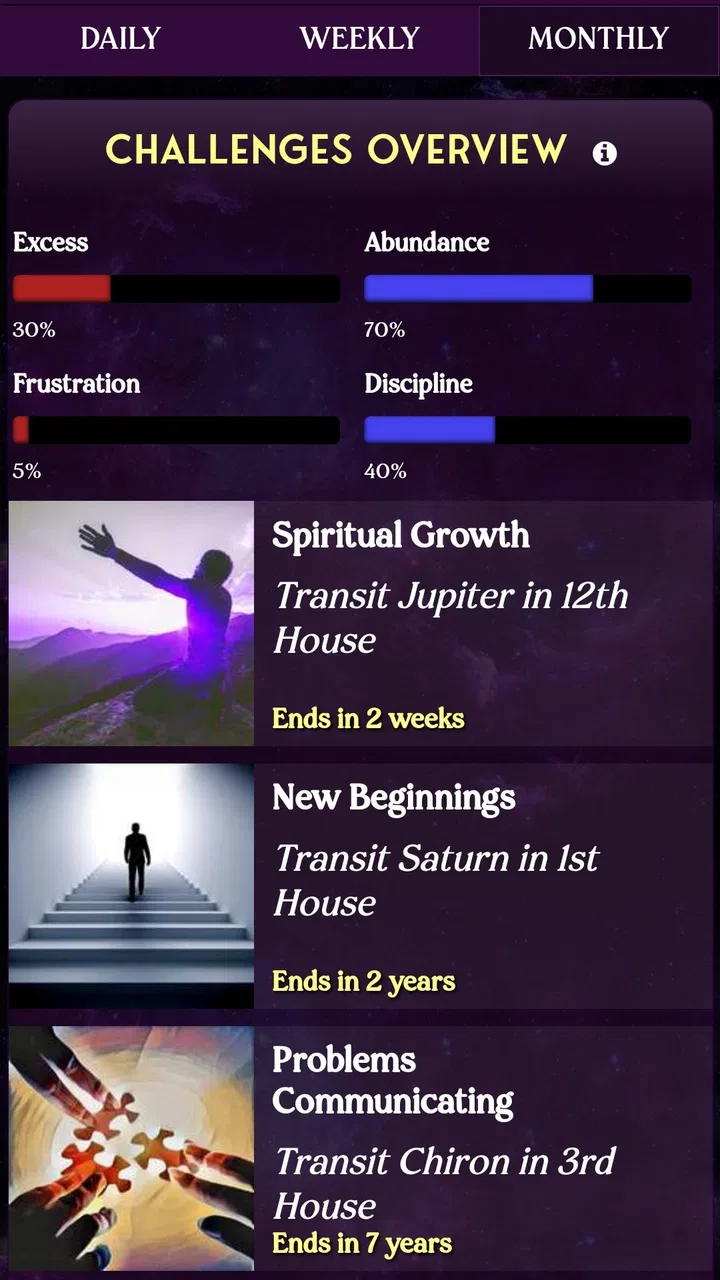
- and transit-based horoscope insights.
- Supports multiple birth charts for comparing relationships or family members.
- Clean interface makes complex astrological information easier to explore.
Cons
- Many advanced readings and features require in-app purchases or subscriptions.
- Accurate results depend on entering the correct birth time and location.
- The amount of information can feel overwhelming for first-time users.
- Some interpretations may seem repetitive across different chart sections.
- Astrology content is subjective and should not replace professional advice.

AstroMatrix Birth Horoscopes
Gallery